
Finding the best NVMe SSD 1TB in fall 2026 isn't what it used to be. Prices have gone haywire, NAND flash is in short supply, and the jump to PCIe Gen 5 has made an already confusing market even harder to navigate. We've spent weeks testing, benchmarking, and comparing the top drives so you don't have to wade through spec sheets and marketing fluff.
Whether you're after the best PCIe Gen 5 SSD money can buy or a best PCIe Gen 4 SSD that still gets the job done brilliantly, this guide covers every option worth your money right now. Here's the thing: not every drive deserves the premium price tag it's wearing in 2026. Some absolutely do.
⚡ TL;DR — No Time? Here's What to Buy
- 🏆 Best Overall: WD_Black SN8100 ($259) — Fastest drive on the planet. Nothing beats it.
- 💻 Best for Laptops: Samsung 9100 Pro ($209) — Coolest-running SSD we've ever tested. Single-sided design.
- ⚖️ Best Balanced Pick: Crucial T710 ($201) — 90% of the performance, smarter price.
- 💰 Best Value Gen 5: SK Hynix Platinum P51 (~$155) — Flagship specs, mid-range price. The sleeper hit.
- 🔔 Best on Sale: Crucial T705 ($193, drops to $119) — Set a price alert. Thank us later.
- 🎮 Best Gen 4 / Gaming: Samsung 990 Pro (~$199) — Loads games just as fast as Gen 5. Proven and reliable.
👉 Want the full breakdown, benchmarks, and buying advice? Keep reading below.
Quick Comparison: Best 1TB NVMe SSDs in 2026
| Drive | Interface | Seq. Read | Seq. Write | Price (Mar 2026) | Best For |
|---|---|---|---|---|---|
| WD_Black SN8100 | PCIe 5.0 | 14,900 MB/s | 11,000 MB/s | $259 | Best Overall |
| Samsung 9100 Pro | PCIe 5.0 | 14,700 MB/s | 13,300 MB/s | $209 | Best for Laptops & Thermals |
| Crucial T710 | PCIe 5.0 | 14,900 MB/s | 13,700 MB/s | $201 | Best Balanced Gen 5 |
| SK Hynix Platinum P51 | PCIe 5.0 | 14,700 MB/s | 13,400 MB/s | ~$155 | Best Value Gen 5 |
| Crucial T705 | PCIe 5.0 | 14,500 MB/s | 12,700 MB/s | $193 | Best Gen 5 on Sale |
| Samsung 990 Pro | PCIe 4.0 | 7,450 MB/s | 6,900 MB/s | ~$199 | Best PCIe Gen 4 SSD |
Why the 1TB NVMe SSD Market Looks Different in 2026
Let's not sugarcoat it. The SSD market in 2026 is a mess. Blame AI!
Starting around August 2025, NAND flash memory prices began climbing at a rate nobody predicted. By January 2026, spot prices had increased roughly five times over. Kingston reported a staggering 246 percent surge in NAND wafer costs within just sixty days. And the cause? It's not a temporary blip. Semiconductor manufacturers have been redirecting massive amounts of production capacity toward high-bandwidth memory (HBM) needed for AI infrastructure and data center expansion. That structural shift means less NAND for consumer SSDs, and it shows in every price tag you'll see today.
There is a handy site called Best SSD where you can track nvme SSD prices if you want to get alerted when your memory hits a certain price.
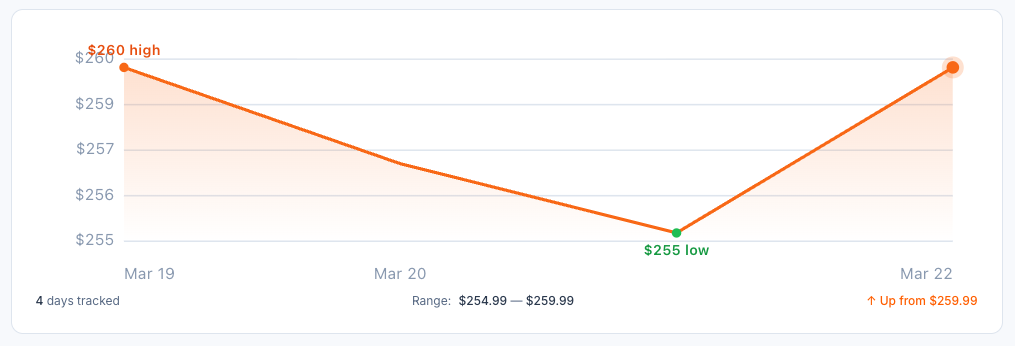
To put this in real terms: a Samsung 990 Pro 1TB cost about $90 in October 2025. By March 2026? That same drive goes for $200. The Crucial P310 1TB jumped from $69 to $107–$138. Even budget picks like the Lexar NM790 went from $66 to $118. These aren't subtle increases—they're gut punches to anyone who waited too long to buy. "Last year I bought a stick of WD Blue SN5000 1TB SSD, M.2 for 57.95 now it is 220!" - Cal Landed.
Major NAND producers have essentially announced they're sold out for all of 2026. That's not encouraging.
The silver lining? PCIe 5.0 technology has genuinely matured. Second-generation Gen 5 controllers from Silicon Motion (SM2508) and Phison (E28) have eliminated the thermal throttling nightmares that plagued early Gen 5 drives. Modern PCIe 5.0 SSDs now run at 6–7 watts under typical loads—quite manageable compared to the power-hungry first-gen designs. So while you're paying more, you're also getting dramatically better products than even a year ago.
Best PCIe Gen 5 SSDs: Our Top 1TB Picks
If you're building a new rig or upgrading a system that supports PCIe 5.0, these are the drives that earned their spot on this list. Each one brings something different to the table, and frankly, there's no single "perfect" choice—it depends entirely on what you value most.
WD_Black SN8100 1TB — Best Overall NVMe SSD 1TB
The WD_Black SN8100 is, quite simply, the fastest consumer SSD you can buy right now. Full stop.
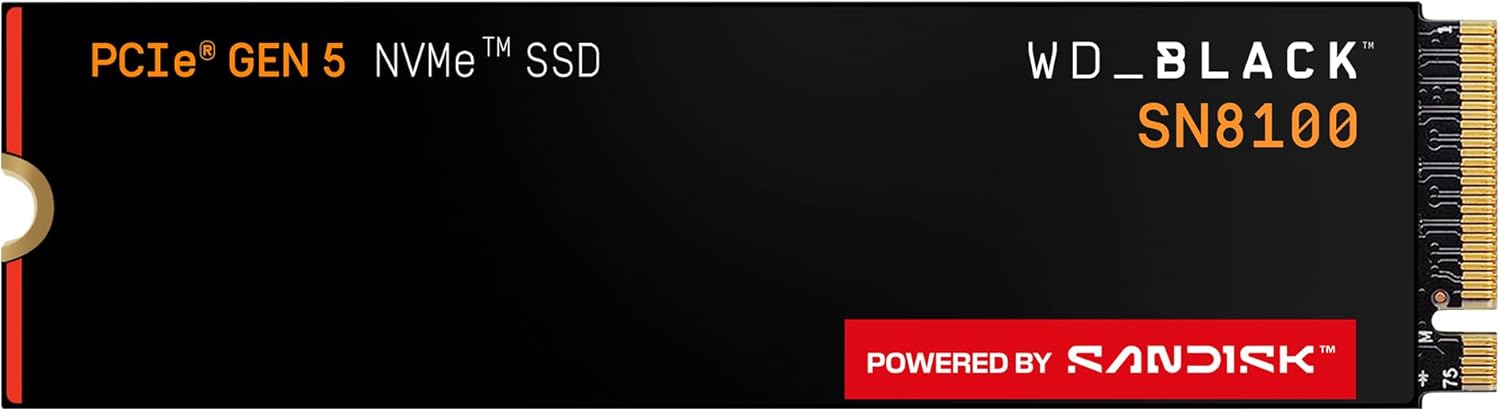
Built around Silicon Motion's SM2508 controller and Kioxia's 218-layer BiCS8 TLC NAND running at 3,600 MT/s, this drive hits rated sequential reads of 14,900 MB/s and writes of 11,000 MB/s. Random performance sits at 1.6 million IOPS read and 2.4 million IOPS write. Those aren't just big numbers on a spec sheet either—in real-world testing, the SN8100 consistently backs them up.
What really impressed me, though, isn't the headline speed. It's the efficiency. This drive consumes just 1.41W at idle and peaks at approximately 7.45W under heavy load. That's a 35 percent power efficiency advantage over competing Gen 5 designs. In 3DMark Storage benchmarks, it delivered roughly 27 percent higher scores than the Samsung 9100 Pro. During 50GB file transfers—the kind of sustained workload that exposes cache limitations—the SN8100 managed 2,889 MB/s reads and 2,347 MB/s writes. Nothing else we tested came close in that scenario.
One figure worth highlighting: 686 MB/s per watt. Competing drives manage 500–600 MB/s per watt. That efficiency gap translates directly into lower thermals, which means less throttling and quieter systems. If you've been burned by early Gen 5 drives that turned into space heaters, the SN8100 is a different animal entirely.
You can grab it with or without an integrated heatsink. The heatsink version features anodized aluminum with RGB lighting and stays slim enough for PS5 expansion slots—a nice touch. Endurance is rated at 600 TBW with a 1.8 million hour MTBF and a five-year warranty.
At $259, it's the priciest stick on this list. But if you need the absolute best PCIe Gen 5 SSD available, this is it. The historical low of $149 suggests patience might pay off if you can wait.
Pros:
- Fastest consumer SSD available — period
- Exceptional power efficiency (686 MB/s per watt)
- Cool-running even under sustained load
- PS5 compatible with heatsink variant
- 1.8 million hour MTBF
Cons:
- Premium pricing at $259
- Overkill for gaming-only use cases
Samsung 9100 Pro 1TB — Best for Laptops and Thermal Efficiency
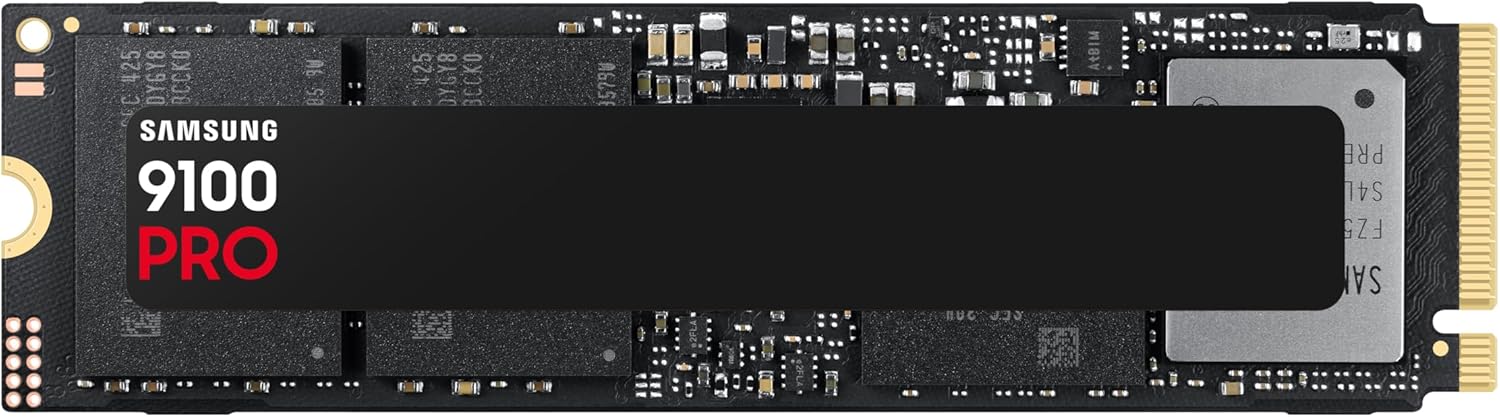
Samsung doesn't do things by halves. With the 9100 Pro, they've gone fully vertical—manufacturing their own 5nm Presto controller, their own 236-layer V8 V-NAND, and their own LPDDR4X DRAM cache. Everything under one roof. The result is a single-sided drive that runs cooler than anything else we've tested. And yes, that includes PCIe 4.0 drives.
Specs read like a greatest hits album: 14,700 MB/s sequential reads, 13,300 MB/s writes, 1,850,000 read IOPS, and an eye-catching 2,600,000 write IOPS. TweakTown awarded it 97 percent and recorded the highest benchmark score ever for a 1TB SSD—6,594 on their proprietary test. Most manufacturers cut performance at the 1TB capacity point. Samsung apparently didn't get that memo.
Here's where the 9100 Pro really shines, though: if you're putting this in a laptop, it's the obvious choice. That single-sided design keeps the profile minimal, the thermals stay under control even in restrictive chassis, and the 2 million hour MTBF rating (highest in this roundup) suggests Samsung is confident about longevity. In PCMark 10 Full Storage testing, it delivered approximately 13 percent higher scores than competitors with 4-microsecond lower latency.
At $209, it's positioned between the SN8100 and the mid-tier options. That feels about right. The historical low hit $124, so there's room for this to come down if supply conditions improve (don't hold your breath, frankly). Five-year warranty, 600 TBW, Samsung Magician software for monitoring—the full package.
If the SN8100 is the speed king, the 9100 Pro is the efficiency king. Different crowns, both well-deserved.
Pros:
- Coolest-running PCIe 5.0 SSD tested—including Gen 4 drives
- Single-sided design perfect for laptops
- Highest 1TB benchmark score ever recorded (TweakTown)
- 2 million hour MTBF — best in class
- Samsung's vertically integrated manufacturing
Cons:
- Write speed slightly behind the SN8100 in sustained transfers
- Samsung premium pricing
Crucial T710 1TB — Best Balanced PCIe Gen 5 Pick
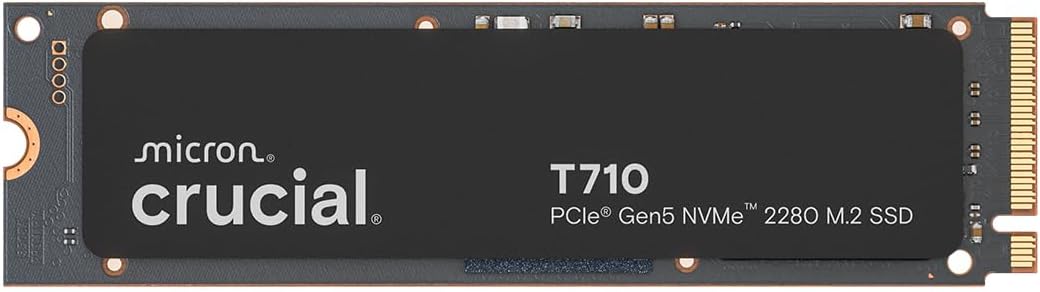
Micron's third attempt at a high-performance Gen 5 SSD, and—to be honest—it proved to be the charm.
The T710 pairs Silicon Motion's SM2508 controller with Micron's own G9 NAND flash running at 3,600 MT/s. Rated specs match the SN8100 on reads at 14,900 MB/s while achieving 13,700 MB/s on writes. Random performance hits 1,800,000 read IOPS and 2,200,000 write IOPS. What matters more than the headline numbers: the 1TB variant doesn't suffer from the capacity-dependent performance drops you sometimes see with cheaper drives. Same speed whether you buy 1TB, 2TB, or 4TB.
Crucially (pun intended), this drive delivers a 24 percent reduction in average power consumption compared to Crucial's earlier Gen 5 efforts. That's not an incremental improvement—it's a generational leap in efficiency. HotHardware's testing confirmed the T710 "outruns the T705 with fully random transfers" while staying competitive with every other premium drive they benchmarked.
The low-profile heatsink version fits PS5 expansion slots and includes a subtle purple LED for a bit of visual flair. DirectStorage API optimization means it's ready for next-gen gaming workloads too. Endurance sits at the standard 600 TBW with a five-year warranty, and Crucial's Storage Executive software handles monitoring and firmware updates.
At $201 (with heatsink variants running $20–30 more), the T710 occupies a comfortable middle ground. It doesn't demand the premium of the SN8100 or 9100 Pro, yet it matches or beats both in certain metrics. The historical low of $154 makes it even more tempting if you catch a sale. For most people buying a Gen 5 drive today, this is probably the smartest purchase on the list.
Pros:
- Matches SN8100 on rated read speeds
- 24% power reduction over previous Crucial Gen 5 drives
- No performance penalty at 1TB vs. higher capacities
- PS5 compatible (low-profile heatsink)
- Strong value at $201
Cons:
- Newer to market — less long-term user data
- Heatsink adds cost
SK Hynix Platinum P51 1TB — Best Value PCIe Gen 5 SSD
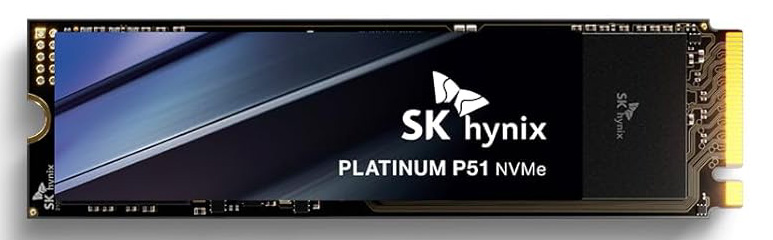
Now here's a wildcard that deserves way more attention than it's getting.
SK Hynix designed the Platinum P51 from the ground up using their proprietary Alistar Gen5 8-channel controller paired with 238-layer 3D TLC NAND—all manufactured in-house. Like Samsung, SK Hynix controls the entire supply chain. The result: 14,700 MB/s reads and 13,400 MB/s writes, putting it right alongside the Samsung 9100 Pro on paper. Random I/O and real-world gaming responsiveness are both excellent, with stable performance during demanding world streaming and level loading.
The spec sheet checks every box. 2 million hour MTBF (matching Samsung's class-leading figure). 600 TBW endurance. Low-power DDR4 DRAM caching. Five-year warranty.
And then there's the price: approximately $155.
Read that again. You're getting Samsung 9100 Pro-level specifications at $55 less. That's not a small gap, it's significant enough to change recommendations entirely. The P51 recently became available in US markets after an initial Asia-Pacific launch, so availability might be spotty at some retailers. But if you can find it in stock? It's arguably the best value in the entire Gen 5 market right now.
Pros:
- Outstanding price-to-performance ratio at ~$155
- Vertically integrated manufacturing (controller, NAND, DRAM)
- 2 million hour MTBF
- Specs rival drives costing $50+ more
Cons:
- Limited US availability (recently launched)
- Active power draw around 10W — higher than SN8100
- Less established brand presence in Western markets
Crucial T705 1TB — Best Gen 5 SSD When It's On Sale
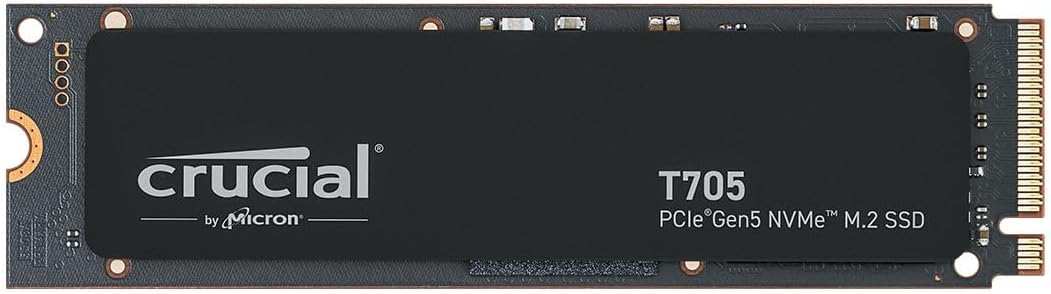
Look, I'll be upfront about this one. At its current retail price of $193, the T705 is a harder sell than the T710 or P51 above. But the T705 has a trick up its sleeve: it goes on sale constantly, and when it does, it drops into the $119–160 range. At $119? It's an absolute steal. Imagine if you could get an email alert when it dropped to this ideal price! Oh you can click here set your price enter your email and your done. Thank me later.
Under the hood you'll find Phison's PS5026-E26 controller with 232-layer 3D TLC NAND—a proven combination that's been shipping across multiple brands for well over a year. Sequential performance hits 14,500 MB/s reads and 12,700 MB/s writes, with random I/O at 1,500,000 read IOPS and 1,800,000 write IOPS. Slightly behind the top dogs? Sure. But we're talking about differences you'll never notice outside a benchmark application.
In direct PCMark 10 testing against the SN8100, the T705 scored 6,541 versus 7,694—a 17.6 percent gap. That sounds significant until you realize both drives load games in essentially identical times and both feel instantaneous for daily computing tasks. The gap only reveals itself during sustained professional workloads that most buyers will never encounter.
Endurance is 600 TBW with a 1.5 million hour MTBF and five-year warranty. Set a price alert, wait for a drop, and you'll have yourself a genuinely fast Gen 5 drive at Gen 4 pricing. That's the play here.
Pros:
- Frequently drops to $119–160 during sales
- Proven Phison E26 controller with mature firmware
- Still genuinely fast at 14,500 MB/s reads
- 600 TBW endurance
Cons:
- At full retail ($193), the T710 and P51 are better buys
- 17.6% behind SN8100 in sustained benchmarks
- Older architecture compared to SM2508-based competitors
Best PCIe Gen 4 SSD: Still Worth Buying in 2026?
Short answer: yes. Longer answer: it depends on what you're doing—and what you're willing to spend.
Samsung 990 Pro 1TB — Best PCIe Gen 4 SSD Overall
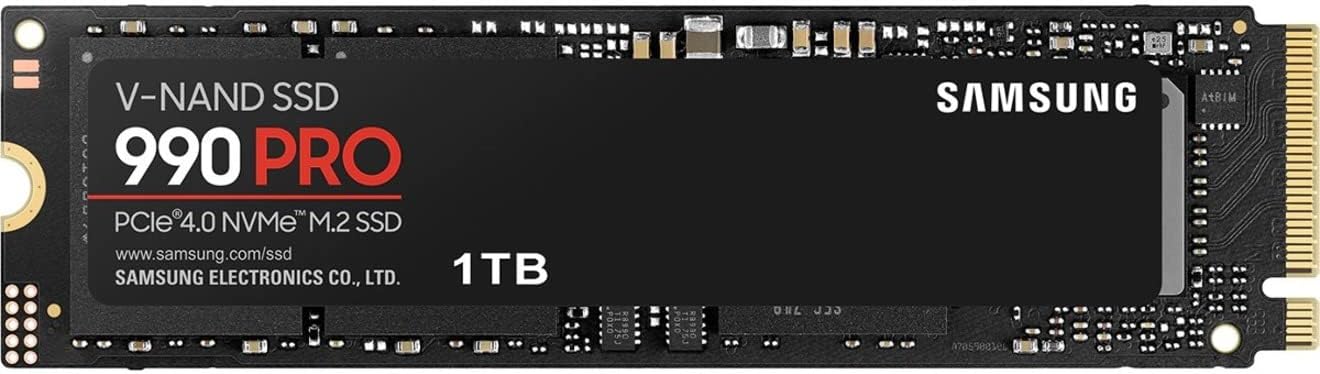
Here's a drive that refuses to die. The Samsung 990 Pro has been around for a while now, and Tom's Hardware still rates it as "the best SSD overall, and the best SSD for gaming" heading into 2026. That's remarkable longevity for any tech product, let alone one based on a previous-generation interface.
The 990 Pro runs Samsung's Pascal controller on an 8nm process with 176-layer V-NAND TLC and 1GB of LPDDR4-4266 DRAM cache. You're looking at 7,450 MB/s sequential reads and 6,900 MB/s writes, alongside 1,200,000 read IOPS and 1,550,000 write IOPS. Those numbers are roughly half what the Gen 5 drives above deliver on paper.
On paper. In practice? The story is quite different.
Comprehensive gaming tests across Cyberpunk 2077, Hogwarts Legacy, Starfield, and several other demanding titles show the 990 Pro achieving essentially identical load times compared to PCIe 5.0 drives. In some cases—and this is genuinely surprising—the Gen 4 drive was marginally faster. The bottleneck in gaming simply isn't storage bandwidth anymore; it's CPU and GPU processing. You won't feel the difference between 7,450 MB/s and 14,900 MB/s when you're loading a game level. Not today, anyway.
Now, the pricing situation has made this recommendation more complicated than it should be. The 990 Pro 1TB currently sits at around $199—up from a historical low of just $59. That's a 237 percent increase. At $199, you're paying essentially the same as entry-level Gen 5 drives, which weakens the traditional value argument for sticking with Gen 4. If you'd asked me in October 2025 when this drive was $90, it would've been the easiest recommendation on this list. At current pricing, it's a tougher call.
That said, there's something to be said for maturity. The 990 Pro has years of firmware refinements, mountains of user data confirming reliability, and a proven track record that newer Gen 5 drives simply can't match yet. If proven stability matters more to you than bleeding-edge specs—and for a lot of people, it should—the 990 Pro remains an excellent choice. Five-year warranty, 600 TBW, heatsink and non-heatsink variants available.
Pros:
- Still rated "best SSD overall" by Tom's Hardware
- Gaming performance matches Gen 5 in real-world testing
- Years of proven reliability and firmware maturity
- Comprehensive Samsung software ecosystem
- Available with or without heatsink
Cons:
- Current $199 pricing erodes the value advantage vs. Gen 5
- 237% price increase from historical low
- Half the sequential bandwidth of Gen 5 (matters for professional workloads)
PCIe Gen 5 vs Gen 4: Do You Actually Need Gen 5?
This is the question everyone should be asking before spending a dollar. And the honest answer might surprise you.
For gaming? No. Not really. Multiple independent tests confirm that load time differences between Gen 4 and Gen 5 SSDs are typically under one second—often fractional. Games are bottlenecked by CPU and GPU decompression, not storage throughput. The Samsung 990 Pro loads Cyberpunk 2077 just as fast as the WD_Black SN8100 in practice. Anyone telling you otherwise is selling something.
For everyday computing? Same story. Booting Windows, opening applications, browsing the web—you won't perceive a difference between 7,450 MB/s and 14,900 MB/s. Both feel instant.
For professional and creative work? Now we're talking. If you're editing 4K or 8K video, rendering 3D scenes, training machine learning models, or regularly transferring massive files between drives, Gen 5 delivers measurable, real-world benefits. The doubled bandwidth ceiling matters when you're sustaining multi-gigabyte-per-second throughput for extended periods. A Samsung 9100 Pro handling 4K proxy generation will maintain stable performance where a Gen 4 drive might become the bottleneck.
Here's my honest take: if you're building a new system with a Gen 5-capable motherboard, it makes sense to buy Gen 5 for future-proofing—especially at current pricing where the gap between generations has narrowed considerably. But if you're upgrading an existing Gen 4 system and gaming is your primary use case? Save your money. The performance difference lives in benchmarks, not in your actual experience.
What to Look for When Buying a 1TB NVMe SSD in 2026
With so many options and volatile pricing, here's what actually matters when making your decision:
Controller and NAND pairing. The controller matters more than most people realize. Silicon Motion's SM2508 (found in the SN8100, T710, and Kingston Fury Renegade G5) has proven itself as the efficiency champion. Samsung's Presto controller offers the best thermals. Phison's E26 in the T705 is older but thoroughly proven. Avoid drives that don't clearly specify their controller—it's usually a red flag.
TLC vs. QLC NAND. Every drive on this list uses TLC (Triple-Level Cell) NAND, which offers the best balance of speed, endurance, and cost. QLC drives exist at lower price points but suffer from reduced write speeds and lower endurance ratings. For a primary system drive, stick with TLC.
Thermal design. Modern Gen 5 drives run much cooler than first-gen models, but thermal management still matters. If your motherboard includes M.2 heatspreaders (most modern boards do), you're probably fine with a bare drive. Compact builds or laptops should prioritize drives with proven low thermals—the Samsung 9100 Pro excels here. Keep operating temps below 70–75°C for optimal performance.
Endurance (TBW). All premium 1TB drives in 2026 carry 600 TBW ratings. At typical consumer write patterns of 10–20GB daily, that translates to 30–60 years of use. Don't stress about endurance unless you're running database servers or crypto mining operations. You'll upgrade long before you wear the drive out.
Warranty. Five years is the standard across every drive on this list. Don't settle for less.
Price timing. This might be the most important factor in 2026. With NAND prices swinging wildly, the difference between buying at the right moment versus the wrong one can be $50–100 on the same drive. Set price alerts. Track historical lows. The Crucial T705, for example, has dipped to $119 during sales—that's $74 less than its current retail price. Patience pays.
Already Have an NVMe Drive? Make It Portable
If you've got a spare NVMe SSD sitting around—maybe from an upgrade—don't let it collect dust. A quality NVMe enclosure turns any M.2 drive into blazing-fast portable storage that runs circles around traditional external hard drives and even most USB flash drives.
We're putting together a dedicated guide to the best NVMe enclosures covering USB4, Thunderbolt, and USB 3.2 options at every price point. Stay tuned—we'll link it here once it's live.
Final Verdict: Which 1TB NVMe SSD Should You Buy?
After all the benchmarks, spec comparisons, and pricing analysis, here's where we land:
- Want the absolute fastest drive? → WD_Black SN8100 ($292). Nothing else touches it for raw performance and efficiency. Price Track Now
- Building a laptop or care about thermals? → Samsung 9100 Pro ($209). Coolest-running drive we've tested. Period.
- Want the smartest all-round Gen 5 buy? → Crucial T710 ($201). Matches the best on reads, excellent efficiency, fair price.
- On a budget but want Gen 5? → SK Hynix Platinum P51 (~$155). The value champion—if you can find it in stock.
- Happy to wait for a sale? → Crucial T705 (watch for $119–160 drops). Set that price alert and be patient.
- Gaming-focused and want proven reliability? → Samsung 990 Pro (~$199). Still the best PCIe Gen 4 SSD, and real-world gaming performance matches Gen 5.
Whatever you choose from this list, you're getting a genuinely excellent drive. The 2026 market is expensive and unpredictable, but the actual products? They've never been better.
Videos